What you will learn
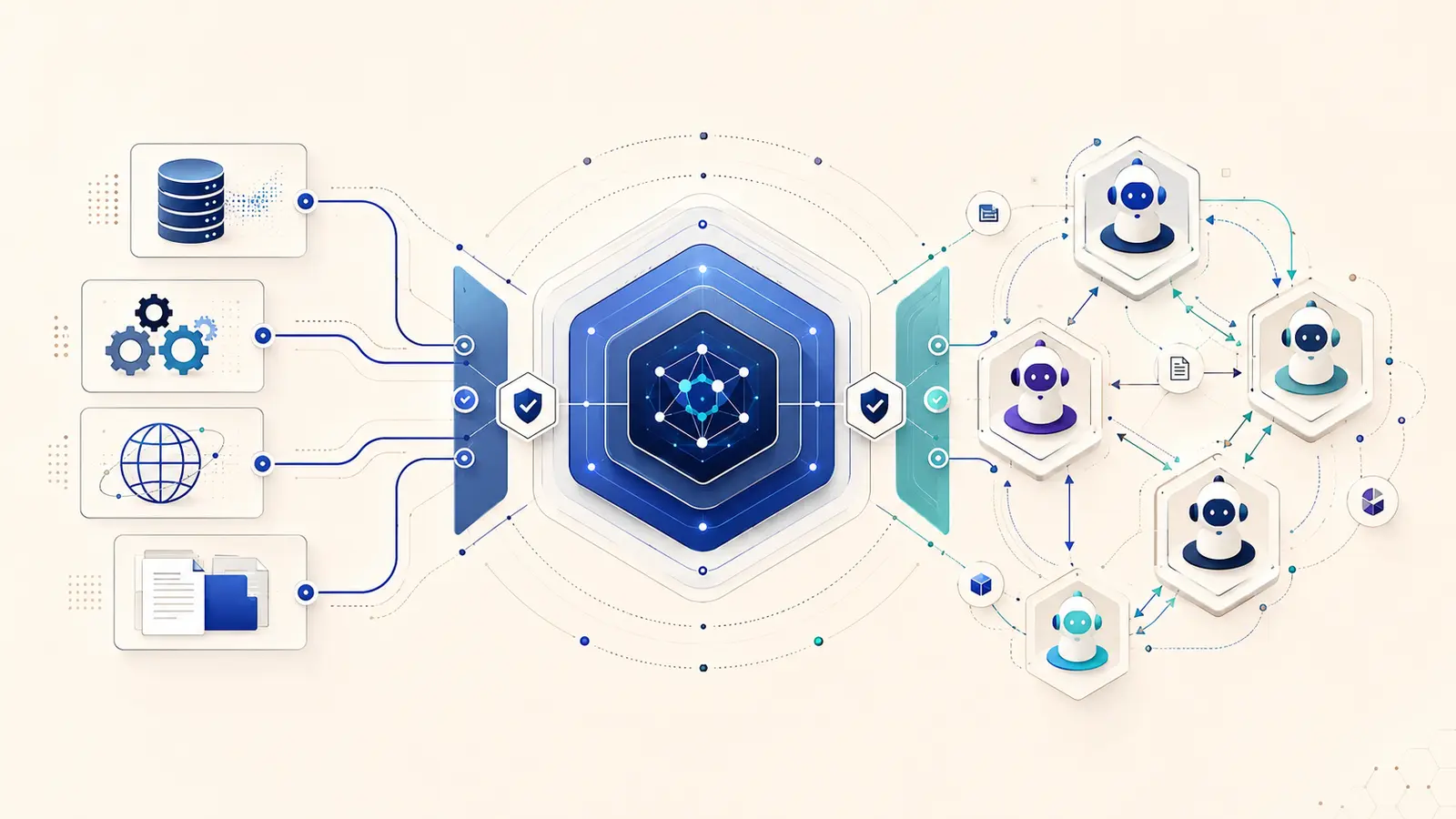
- MCP connects an AI application to tools, data, prompts, and other context; A2A lets independent agents discover one another, exchange messages, manage tasks, and return artifacts.
- The protocols are complementary. A multi-agent product can use A2A at the agent boundary and MCP inside each agent to reach its approved tools and information.
- Protocol adoption does not create trust by itself. Identity, authorization, data classification, approval gates, observability, and evaluation remain application responsibilities.
01
The short answer: MCP and A2A solve different boundaries
The Model Context Protocol (MCP) and Agent2Agent Protocol (A2A) are often presented as rivals because both appear in diagrams of agentic systems. That framing is misleading. MCP standardizes how an AI application connects to capabilities and context. A2A standardizes how one independently operated agent communicates and collaborates with another. The useful question is therefore not which protocol wins, but which boundary the architecture needs to make explicit.
Think of an internal procurement agent. It may use MCP to query an approved supplier database, read policy documents, call a price-calculation tool, and request a user clarification. If it delegates vendor-risk analysis to a separate compliance agent owned by another team, A2A can carry the task, progress updates, clarification messages, and final artifact between those agents. The compliance agent may then use its own MCP servers to reach sanctioned records and tools. One protocol connects an agent to capabilities; the other connects agents to agents.
This separation matters operationally. Tool calls are usually narrow, typed, and controlled by the host application. Cross-agent work can be longer-running, stateful, asynchronous, and owned by a different security or organizational domain. Treating both interactions as generic API calls hides lifecycle, trust, and governance decisions that should remain visible.
- Use MCP when the immediate need is controlled access to tools, resources, or reusable prompt workflows.
- Use A2A when an agent must discover or collaborate with another agent while preserving task state and artifacts.
- Use both when specialized agents collaborate and each agent also needs governed access to its own tools and data.
02
What MCP standardizes in the 2026 specification
MCP defines a client-server protocol for exchanging context and capabilities between a host AI application and MCP servers. Servers can expose resources, prompts, and tools. Resources make contextual material available, prompts provide reusable interaction templates, and tools expose callable operations. The host remains responsible for user experience, model orchestration, consent, permissions, and deciding which server responses enter the model context.
The July 28, 2026 MCP specification made the protocol easier to operate in modern distributed environments. Its release notes highlight a stateless core, multi-round-trip requests, routing through headers, cacheable list results, strengthened authorization, and formal extensions. Those changes improve transport and deployment flexibility, but they do not turn every MCP server into a trusted dependency. A server can still expose excessive data, misleading tool descriptions, unsafe parameters, or content that attempts to influence the model.
A strong MCP implementation uses capability discovery as an input to policy, not as automatic permission. The host should maintain an allowlist of servers, validate schemas, scope credentials, separate read and write tools, label untrusted content, record every invocation, and require approval before high-impact actions. The model may recommend a tool; deterministic application logic should decide whether that tool can actually run.
- Resources: files, records, documentation, or other context the application may read.
- Prompts: server-provided templates or workflows that a user or application can select.
- Tools: named operations with defined inputs and outputs, such as search, calculation, or record creation.
- Client capabilities: optional functions such as elicitation that let a server request additional user input through the host.
03
What A2A standardizes for agent collaboration
A2A describes how a client agent discovers and communicates with a remote agent. An Agent Card advertises identity, endpoint information, supported interfaces, skills, and security requirements. Messages carry communication between actors. A task represents a unit of work with a lifecycle, while artifacts represent useful outputs produced during that work. This vocabulary is important because agent collaboration often lasts longer than a single request and may require clarification or progress reporting.
The current A2A specification supports protocol bindings including JSON-RPC, gRPC, and HTTP with JSON. It also defines streaming and asynchronous interaction patterns. A remote research agent, for example, can acknowledge a task, publish status updates, request missing constraints, and later return a structured report artifact. The calling agent does not need access to the remote agent's internal model, prompts, memory, or tools; it needs a reliable contract at the collaboration boundary.
A2A version 1 adds clearer timestamps, extension handling, and authorization scoping. That helps interoperability, but an Agent Card should never be treated as proof that an agent is safe, competent, or authorized for a particular business process. Discovery tells you what an agent claims to support. Onboarding, identity verification, contractual trust, test evidence, and runtime policy determine whether the claim can be used.
- Agent Card: discoverable description of an agent's endpoint, skills, interfaces, and security expectations.
- Message: communication that can initiate work, add context, or answer a clarification.
- Task: stateful unit of work that can move through submitted, working, input-required, completed, failed, or canceled states.
- Artifact: a deliverable such as a report, plan, structured dataset, or generated file.
04
MCP vs A2A comparison table
The comparison below is deliberately architectural. Vendors can package either protocol in different products, so protocol labels alone do not guarantee a particular hosting model, model provider, or trust level.
| Decision | MCP | A2A |
|---|---|---|
| Primary purpose | Connect an AI host to context and capabilities | Connect independent agents for collaboration |
| Typical counterpart | Tool, data, prompt, or service adapter | Remote or separately operated agent |
| Core objects | Resources, prompts, tools, capabilities | Agent Cards, messages, tasks, artifacts |
| Interaction shape | Often targeted capability invocation | Often stateful, multi-turn, or long-running work |
| Discovery | Server capabilities and available items | Agent identity, endpoint, skills, interfaces, security |
| Ownership boundary | Commonly inside one product or governed tool estate | Often across teams, products, vendors, or trust domains |
| Best fit | Give an agent approved access to systems | Delegate an outcome to a specialist agent |
| Main risk to manage | Overprivileged tools and untrusted context | Untrusted agents, task delegation, and artifact provenance |
05
A reference architecture that uses both protocols
Start with a user-facing orchestrator rather than a fully connected mesh. The orchestrator authenticates the user, classifies the request, applies policy, and determines whether the work can be completed locally. Local capabilities are exposed through a small set of approved MCP servers. When a task requires another specialist, the orchestrator selects an onboarded A2A agent from a registry and sends a bounded task with explicit deliverables, data limits, time limits, and escalation rules.
Suppose an operations team asks for a launch-readiness assessment. The orchestrator uses MCP to read the project's requirements, pull current test results, and calculate coverage. It uses A2A to request a privacy review from a specialist governance agent. That agent uses its own MCP connections to consult the applicable policy library and risk register. It returns an artifact containing findings, evidence references, uncertainty, and required approvals. The orchestrator validates the artifact, reconciles it with local evidence, and presents a combined recommendation to a human owner.
This design avoids giving every agent direct credentials to every system. It also keeps responsibility traceable: MCP logs explain which capabilities each agent used; A2A task history explains what was delegated and returned; application traces connect those events to the user request and final decision.
- Identity layer: authenticate users, workloads, servers, and remote agents separately.
- Policy layer: decide which data and actions are allowed before model execution.
- MCP gateway: expose narrow, reviewed capabilities with per-tool authorization.
- A2A registry: store verified Agent Cards, owners, versions, test status, and allowed use cases.
- Evidence layer: retain task IDs, tool calls, source references, approvals, outputs, and evaluation results.
06
When to use MCP only, A2A only, or both
Use MCP only when one application or agent needs a consistent way to reach several controlled systems. A support assistant that searches a knowledge base, reads an account record, and drafts a reply does not automatically need another agent. Adding A2A would create more discovery, identity, testing, and failure-handling work without improving the user outcome.
Use A2A without MCP when two agents already have self-contained capabilities and only need a stable collaboration contract. A scheduling agent might ask a separately hosted travel agent for itinerary options, while both products keep their internal integrations private. A2A carries the outcome-oriented task; how either agent reaches its own data remains an implementation detail.
Use both when work crosses agent and capability boundaries. This is common in enterprise processes that coordinate research, compliance, finance, engineering, or customer operations. Do not adopt both just to claim a multi-agent architecture. Add a protocol only when it removes a concrete integration problem, improves portability, or makes a trust boundary easier to govern.
07
Security: protocols are contracts, not trust guarantees
The most important control is least privilege. An MCP server used for analysis should not expose an unrestricted delete operation. An A2A research task should not silently authorize a remote agent to contact customers or modify production records. Split read and write capabilities, use short-lived scoped credentials, validate every input and output, and place irreversible or externally visible actions behind explicit approval.
Treat content from tools, resources, agents, and artifacts as untrusted data. Retrieved documents can contain prompt injection. Tool descriptions can be inaccurate. A remote agent can produce an unsupported conclusion while appearing confident. Preserve provenance, label instructions according to authority, isolate data from control messages, and require the final agent to cite the evidence used for important claims.
Versioning also matters. Pin tested protocol and SDK versions where practical, record the Agent Card and MCP capability versions used in each run, and re-evaluate integrations after a material change. A compatible transport does not imply compatible behavior. Regression tests should cover permissions, schemas, timeouts, cancellation, partial results, malicious inputs, and degraded dependencies.
- Authenticate both the human or workload initiating work and the service receiving it.
- Authorize per tool, resource, agent skill, data class, and environment—not only per connection.
- Redact secrets and minimize personal or confidential data before delegation.
- Use budgets for tokens, tool calls, elapsed time, retries, and downstream cost.
- Require provenance and validation before an artifact influences a consequential decision.
- Make cancel, timeout, rollback, and human escalation paths testable.
08
A practical implementation sequence
Begin with a workflow map, not an SDK. Identify the user goal, systems of record, specialist responsibilities, and decisions that require human ownership. Mark each boundary as local capability access, agent delegation, or ordinary deterministic API integration. Many teams discover that only one or two boundaries need a protocol in the first release.
Next, build the smallest end-to-end path with synthetic or low-sensitivity data. Define typed contracts and expected failure behavior before adding more tools or agents. For MCP, test each resource and tool independently and enforce permission checks outside the model. For A2A, test discovery, task creation, input-required states, streaming or polling, cancellation, artifact validation, and duplicate delivery. Then run a combined trace that can explain every step from user request to final answer.
Promote the design only after offline evaluation and controlled observation. Measure task completion, factual support, policy compliance, latency, cost, human correction, and recovery from dependency failure. Expand privileges and autonomy gradually. A protocol migration should reduce custom integration code; it should not lower the evidence required for production readiness.
- 1. Map jobs, owners, data, actions, and approval points.
- 2. Classify each integration boundary before choosing a protocol.
- 3. Define schemas, identity, authorization, budgets, and error behavior.
- 4. Prototype with safe data and a single narrow use case.
- 5. Add tracing and evaluation before adding more autonomy.
- 6. Test adversarial content, outages, cancellation, and version changes.
- 7. Release gradually with a named operational owner and rollback plan.
09
Evaluation metrics that reveal whether the design works
Protocol success is not the number of connected servers or agents. It is the reliable completion of useful work. Track the percentage of tasks that reach an accepted outcome, the percentage that require human correction, and the rate of unsupported claims or policy violations. Break failures down by orchestration, tool selection, tool execution, delegation, remote-agent quality, artifact validation, and final synthesis so the team fixes the right layer.
Operational metrics should include latency percentiles, queue time, tool-call and message counts, token consumption, downstream API cost, cancellation success, retry amplification, and dependency availability. Governance metrics should include permission denials, sensitive-data exposure, missing provenance, unapproved actions, and time to investigate an incident. A small, well-observed system usually creates more value than a large agent mesh whose behavior cannot be reconstructed.
10
The durable decision rule
Choose MCP for the capability boundary and A2A for the collaboration boundary. Keep ordinary APIs and deterministic workflow steps where they remain simpler. The architecture should make identity, authority, state, evidence, and ownership clearer—not merely replace one set of endpoint names with another.
Standards can reduce integration friction and vendor-specific glue, but reliable agent systems still depend on product design. Start with a bounded job, expose the minimum capabilities, delegate only to verified agents, preserve evidence, and evaluate outcomes continuously. That discipline will survive protocol and model changes better than any architecture built around a fashionable acronym.
Copy & adapt
8 prompts for designing and reviewing MCP + A2A systems
These templates turn the comparison into concrete architecture and evaluation work. Replace every bracketed field and keep security decisions under human ownership.
Map every integration boundary
Classify a workflow before selecting MCP, A2A, an ordinary API, or no integration.
Act as a senior AI systems architect. Map the workflow below without assuming that every step needs an agent.

Workflow: [describe the user goal and current process]
Actors and owners: [list]
Systems and data: [list, including sensitivity]
Actions: [read, write, communicate, approve]
Constraints: [latency, residency, compliance, budget]

For each boundary, classify it as: local deterministic step, ordinary API, MCP capability access, A2A agent collaboration, or human decision. Explain the reason, identity involved, minimum permission, state owner, failure mode, and required evidence. Finish with a smallest viable architecture and a list of integrations that should not be added yet.Choose MCP, A2A, both, or neither
Produce a defensible protocol decision instead of following architecture hype.
Evaluate this proposed AI integration: [proposal].

Compare four options: MCP only, A2A only, both protocols, and neither protocol. Score each option from 1 to 5 for interoperability, implementation effort, security complexity, observability, portability, lifecycle fit, and operational cost. State what evidence is missing. Recommend the simplest option that satisfies the actual requirements, identify conditions that would change the decision, and provide a six-week proof-of-concept plan with explicit exit criteria.Review an MCP server capability
Challenge tool scope, schema quality, authorization, and untrusted content handling.
Review the following proposed MCP server as a security-minded platform engineer.

Purpose: [purpose]
Resources, prompts, and tools: [definitions or schemas]
Credentials and authorization: [design]
Data classes: [public, internal, confidential, personal]
Host behavior: [how outputs enter model context]

Identify ambiguous descriptions, excessive permissions, injection paths, unsafe defaults, missing limits, schema weaknesses, secret exposure, and irreversible actions. Rewrite the capability contract with least privilege, typed errors, audit fields, consent points, rate limits, and tests. Do not claim safety when evidence is absent.Review an Agent Card and task lifecycle
Check whether a remote agent is genuinely ready for a bounded production task.
Act as an enterprise integration reviewer. Assess this A2A Agent Card and proposed task lifecycle: [paste details].

Verify claimed skills, interface and protocol versions, authentication, authorization scopes, supported content types, task states, input-required behavior, streaming or polling, cancellation, artifact schemas, retention, and owner contacts. Separate interoperability claims from trust evidence. Return: critical blockers, questions for the agent owner, contract changes, onboarding tests, runtime monitoring, and an approve / conditional approve / reject recommendation with reasons.Threat-model the combined architecture
Trace attacks and control failures across users, models, MCP servers, and A2A agents.
Threat-model this MCP and A2A architecture: [diagram or description].

Assets: [data, credentials, actions, decisions]
Trust boundaries: [list]
Adversaries and failure sources: [list]

Analyze identity spoofing, overbroad authorization, prompt injection, malicious or compromised tools, deceptive Agent Cards, task confusion, artifact tampering, data leakage, replay, denial of service, cost amplification, and unsafe retries. For each risk, provide preconditions, likely impact, prevention, detection, response, and a concrete test. Prioritize by impact and feasibility rather than using generic severity labels.Build an end-to-end agent protocol test plan
Measure quality and recovery across normal, degraded, and adversarial scenarios.
Create an evaluation plan for this agent workflow: [description]. Define an accepted outcome from the user's perspective, then build a test matrix covering normal requests, missing input, ambiguous instructions, tool failure, remote-agent delay, cancellation, duplicate delivery, malformed artifacts, stale versions, prompt injection, permission denial, and partial completion. Specify fixtures, expected traces, metrics, pass thresholds, human review rules, and rollback triggers. Include quality, evidence, security, latency, cost, and recovery metrics.Design observability and incident triage
Create traces that explain what happened without logging unnecessary sensitive data.
Design observability for this MCP and A2A workflow: [description]. Provide a trace model connecting user request, policy decision, MCP invocation, A2A task, messages, artifacts, approvals, final output, and evaluation result. Define correlation IDs, safe log fields, redaction rules, retention, dashboards, alerts, and service-level objectives. Then write a triage playbook for unsupported output, permission breach, stuck task, dependency outage, and cost spike.Plan a version-safe protocol upgrade
Upgrade specifications and SDKs without confusing transport compatibility with behavioral safety.
Plan an upgrade from [current MCP/A2A versions and SDKs] to [target versions]. Inventory affected servers, clients, agents, Agent Cards, schemas, authentication flows, extensions, and monitoring. Identify breaking and behavioral changes using only supplied release notes and official documentation. Propose compatibility tests, shadow traffic, staged rollout, rollback, owner sign-off, and evidence to retain. Clearly label every assumption and unresolved dependency.FAQ
Common questions
Is A2A a replacement for MCP?
No. MCP focuses on an AI application's access to tools, resources, prompts, and context. A2A focuses on communication and task collaboration between independent agents. Many production architectures can use both.
Can an A2A agent use MCP tools?
Yes. A remote agent can use MCP internally to reach its approved capabilities while exposing an A2A interface to other agents. The calling agent does not need direct access to those internal tools.
Do I need both protocols for a single AI assistant?
Usually not. If one assistant only needs controlled access to local tools and information, MCP or ordinary APIs may be sufficient. Add A2A only when collaboration with a distinct agent creates a real operational benefit.
Does using MCP or A2A make an agent secure?
No. The protocols provide interoperable contracts. Security still requires verified identity, least-privilege authorization, data minimization, input and output validation, observability, approvals, testing, and incident response.
What is the biggest architectural mistake with agent protocols?
The most common mistake is adding connectivity before defining authority. Teams should first decide who owns the task, which data and actions are allowed, how success is evaluated, and what happens when a dependency fails.
How should a team evaluate MCP and A2A integrations?
Evaluate accepted task completion, factual support, policy compliance, human correction, latency, cost, cancellation, recovery, and trace completeness. Test each integration separately and then test the full workflow under normal, degraded, and adversarial conditions.
Sources
Primary sources and live documentation
These links point to authoritative documentation used to verify and maintain this guide for the August 2026 update.
Turn the method into a reusable instruction.
Explore expert prompts