Direct answer
The answer in brief
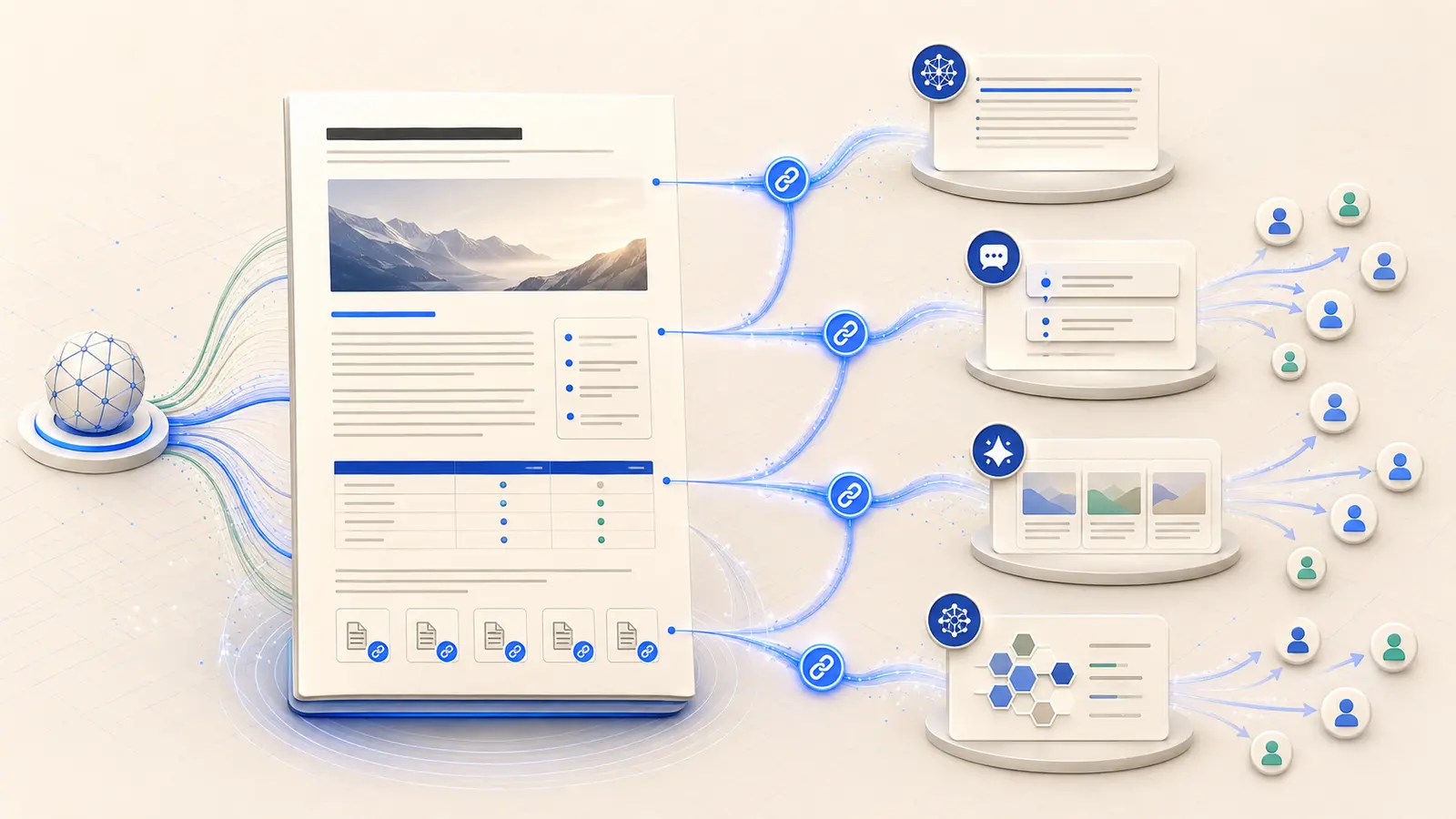
To get traffic from AI search, make every important page crawlable, indexable, easy to retrieve, easy to quote, and worth citing. Publish direct answers supported by original evidence, organize them with descriptive headings and internal links, keep facts current, expose accurate structured data, and measure both citations and qualified referral visits.
Review the 9 cited sources →Key takeaways
- AI search visibility starts with ordinary technical SEO: the page must be accessible, indexable, internally linked, and eligible to appear with a useful snippet.
- Citation-ready content gives a direct answer, defines terms, supports claims with primary evidence, adds original value, and separates facts from interpretation.
- Measure citations, AI referral sessions, engagement, assisted conversions, and query coverage—not rankings alone—and improve pages from observed retrieval gaps.
Field tool
A decision rule you can apply now
Improve the page for people and crawlable search first; add AI-search formatting only when it makes the answer clearer and easier to verify.
Select one existing page, rewrite its opening answer, add a source-backed evidence block, strengthen author identity, and measure impressions and referrals for four weeks.
The update adds definitions or schema but no original evidence, expert judgment, tool, example, or clearer answer.
01
The short answer: earn retrieval, citation, and the click
Getting traffic from AI search is not a separate trick that replaces SEO. It is a three-part job. First, the system must be able to discover and retrieve your page. Second, the page must contain a passage that answers the user's question accurately enough to cite. Third, the source must give the reader a reason to click beyond the generated answer—original data, a useful tool, a complete template, a comparison, a worked example, or deeper expertise.
The industry often calls this generative engine optimization, or GEO. The useful meaning of GEO is straightforward: improve how accurately AI-powered search experiences can find, understand, select, attribute, and link to your content. It is not permission to stuff pages with keywords, publish hundreds of synthetic articles, hide instructions for language models, or add unsupported schema. Those tactics weaken the quality signals that both readers and search systems need.
Google states that its normal SEO best practices remain relevant for AI Overviews and AI Mode and that no special AI file or schema is required. OpenAI says any public site can appear in ChatGPT search and advises publishers not to block OAI-SearchBot if they want content included in summaries and snippets. Bing emphasizes crawlability, clear structure, evidence, freshness, sitemaps, and IndexNow. The durable strategy is therefore excellent web publishing with stronger answer design and better measurement.
- Retrieval: can the system crawl, index, and match the page to the real question?
- Citation: does the page contain a clear, specific, supportable passage worth referencing?
- Click: does the page offer value that cannot be fully replaced by a short generated summary?
- Conversion: does the visit lead naturally to another useful article, tool, subscription, or business outcome?
02
How AI search finds and selects sources
AI search experiences do not simply read every page on the web at answer time. The exact systems differ, but a practical publishing model has five stages: discovery, indexing, retrieval, passage selection, and answer generation with links or citations. A weakness at any stage limits traffic. A strong paragraph cannot be cited if the page is blocked, and a perfectly indexed page may still be ignored if it does not answer the query clearly.
Google explains that AI Overviews and AI Mode can use query fan-out: the system issues several related searches across subtopics and data sources before assembling a response. That creates opportunity beyond one exact keyword. A page about evaluating AI prompts might be retrieved for narrower questions about prompt test cases, scoring rubrics, hallucination checks, or team governance. Covering a topic in coherent, internally linked subpages helps the site address those follow-up intents without forcing one page to rank for everything.
Citation selection rewards usable information, not word count by itself. A system needs to identify what claim a passage makes, the conditions under which it applies, and why the source should be trusted. Definitions, comparison tables, numbered procedures, evidence-backed conclusions, limitations, and concise answers to real questions are easier to reuse accurately than long introductions filled with generalities.
- Discovery signals: internal links, XML sitemap, external references, and timely URL submission.
- Indexing signals: accessible HTML, canonical URLs, useful text, stable status codes, and no accidental noindex.
- Retrieval signals: focused page intent, descriptive headings, entity consistency, and complete topical coverage.
- Citation signals: precise claims, visible evidence, source provenance, originality, freshness, and low ambiguity.
- Click signals: proprietary value, practical assets, depth, trust, and a clear promise beyond the answer preview.
03
Technical eligibility checklist for AI search
Begin with the same technical foundation required for conventional search. Important pages should return a successful HTTP status, render meaningful text without requiring a login, use one self-referencing canonical URL, and be reachable through ordinary HTML links. Keep the XML sitemap complete and use an accurate lastmod value only when the visible content has materially changed. Do not update every date automatically just to appear fresh.
Review robots.txt at the CDN and application level. Google requires a page to be indexed and eligible to show a snippet before it can appear as a supporting link in AI Overviews or AI Mode. OpenAI specifically identifies OAI-SearchBot as the crawler used to discover content for ChatGPT search summaries and snippets. A wildcard allow rule normally permits it, but an explicit group can make the policy easier to audit. Also check firewall, bot-protection, geolocation, and JavaScript challenges that may return a different response to crawlers.
Structured data can help search systems understand the page, but it must describe visible content accurately. Use Article or TechArticle, BreadcrumbList, Organization, and other relevant types. Do not create fake reviews, invisible FAQs, or properties that the page does not support. Google explicitly says there is no special schema required for AI features. Correct markup improves clarity; it does not guarantee inclusion or a citation.
- One crawlable canonical URL for every article; redirect competing versions.
- Useful title, meta description, H1, descriptive H2s, and visible body text.
- Fast, responsive pages with descriptive image alt text and no intrusive interstitials.
- XML sitemap referenced in robots.txt with truthful modification dates.
- Googlebot, Bingbot, and OAI-SearchBot access verified through live URL tests or server logs.
- Valid JSON-LD that matches the article, author or publisher, image, dates, breadcrumbs, and visible FAQ content.
- No accidental nosnippet, restrictive max-snippet, noindex, authentication wall, or CDN bot challenge.
04
Write passages that an answer engine can cite accurately
Give the main answer near the top in approximately two to four sentences. State the recommendation, the mechanism, and the most important qualification. This answer-first block helps readers immediately and provides a self-contained passage for retrieval. It should not repeat the title mechanically or pretend that a complex question has one universal answer.
Build the rest of the article around the questions a serious reader asks next: how it works, when it applies, what evidence supports it, which alternatives exist, what can fail, and how to implement or measure it. Use headings that describe those questions or decisions. A heading such as “How ChatGPT search discovers a page” carries more meaning than “More information.” Each section should make one main point before adding detail.
Support factual claims close to the claim. Link to primary documentation, original research, public datasets, standards, or direct product documentation whenever available. Explain what the source establishes and where your interpretation begins. If a statistic is time-sensitive, name the period and update it when the underlying source changes. AI systems can repeat unsupported precision just as easily as humans can, so provenance is part of content quality.
- Define the term before using an acronym such as GEO, RAG, MCP, or A2A repeatedly.
- Place a concise answer before the deeper explanation.
- Use tables for repeated comparisons and numbered steps for procedures.
- Include examples with real inputs, decisions, and outputs—not generic slogans.
- State limitations, exceptions, dates, and uncertainty explicitly.
- Attribute external facts and make your original contribution obvious.
05
Create information gain that gives people a reason to visit
A summary engine can replace a page that merely restates common knowledge. It is much less able to replace a page that contains original evidence or a useful asset. Information gain means adding something the competing pages do not provide: a tested prompt with its evaluation rubric, an experiment, a benchmark methodology, annotated examples, a decision matrix, a calculator, a downloadable checklist, or a transparent synthesis of several primary sources.
For Intelligence Prompting, the strongest advantage is not producing the largest number of prompts. It is showing how a prompt becomes a reliable workflow. Every major article should connect the instruction to context requirements, evidence rules, failure handling, output format, and a verification step. When appropriate, include the copy-ready template, a filled example, and a short explanation of why each component exists.
Originality does not require an expensive laboratory. A small, well-documented test can be valuable when the method is reproducible. Describe the models and dates tested, inputs, success criteria, limitations, and observed failures. Never convert a tiny test into a universal claim. Honest scope makes a result more credible and more useful as a citation.
- Tested templates with acceptance criteria and failure examples.
- Original diagrams that explain architecture or decision flow.
- Comparison tables based on current primary sources.
- Reusable checklists, scorecards, and implementation sequences.
- Transparent mini-studies with documented methods and limitations.
- Free interactive tools that solve the next step after the AI answer.
06
Platform differences: Google, ChatGPT, and Bing Copilot
The same high-quality page can appear across several AI search experiences, but discovery and reporting differ. Google AI Overviews and AI Mode are part of Google Search. Google says there are no additional eligibility requirements beyond being indexable and eligible for a snippet, and its AI features may retrieve multiple supporting pages through query fan-out. Conventional SEO, internal linking, page experience, text availability, images, and accurate structured data remain the foundation.
ChatGPT search can surface public pages and attach links or citations to generated answers. OpenAI tells publishers to allow OAI-SearchBot for inclusion in summaries and snippets. Referral URLs include utm_source=chatgpt.com, which makes visits identifiable in analytics. GPTBot is a separate control associated with potential model training; allowing search discovery does not require a publisher to make the same policy choice for training.
Microsoft now provides an AI Performance view in Bing Webmaster Tools for supported sites. It reports citations, cited pages, grounding queries, and visibility trends across Copilot, Bing AI summaries, and selected integrations. Bing also recommends accurate sitemaps and IndexNow to communicate additions, updates, and removals quickly. These tools do not guarantee citation, but they shorten the feedback loop between publishing and measurement.
| Experience | Discovery foundation | What to optimize | How to measure |
|---|---|---|---|
| Google AI Overviews and AI Mode | Google index and snippet eligibility | People-first depth, internal links, clear text, images, page experience, accurate schema | Search Console web performance; dedicated generative AI reports where available; analytics |
| ChatGPT search | Public web discovery with OAI-SearchBot and search providers | Crawl access, self-contained answers, original evidence, clear source identity | Referrals containing utm_source=chatgpt.com; landing-page engagement and conversions |
| Bing Copilot and AI summaries | Bing index, sitemaps, and optional IndexNow notifications | Clear headings, tables, FAQs, evidence, freshness, consistent entities | Bing Webmaster Tools AI Performance, grounding queries, citations, cited pages |
| Other answer engines | Their crawler, licensed index, or external search partner | Accessible canonical pages, strong topical relevance, attributable evidence | Referral reports, server logs, brand mentions, and assisted conversions |
07
Build a topical cluster instead of chasing isolated keywords
AI search questions are often conversational and multi-step. One page should satisfy one main intent, while a cluster covers the related decisions. Start with a durable pillar, then create focused supporting pages that answer questions with different evidence or formats. Link them with descriptive anchor text so readers and retrieval systems can understand the relationship.
A prompt-engineering cluster might begin with “how to write AI prompts,” then connect to prompt frameworks, context engineering, evaluation rubrics, prompt injection, reusable team libraries, agent prompts, multimodal prompting, and model-specific implementation notes. A page about AI agent prompts should link back to the general prompting method and forward to agent evaluation and tool security. This creates a coherent knowledge graph without repeating the same article under several titles.
Map each page to a question, audience, and unique contribution before writing. If two planned URLs would produce nearly identical answers, combine them. Near-duplicate pages blur intent and divide links, engagement, and crawl attention. A smaller set of distinctive, well-maintained resources is more defensible than a large archive of keyword variants.
- Pillar: a complete guide to the broad job or concept.
- Method pages: frameworks, implementation steps, and evaluation.
- Decision pages: comparisons, alternatives, and selection criteria.
- Risk pages: failure modes, security, governance, and limitations.
- Asset pages: tools, templates, scorecards, examples, and datasets.
- Update pages: genuinely new releases or evidence, consolidated into evergreen pages when the news is no longer distinct.
08
A citation-ready on-page blueprint
A citation-ready page is designed for both fast comprehension and deep verification. Its title promises one clear outcome. The introduction answers the main question. The body breaks the problem into mechanisms, decisions, implementation, evidence, and limitations. The page then offers a next action that is more useful than the generated summary.
Use this blueprint as a quality checklist rather than a rigid word-count formula. A 1,200-word page can be the best result for a narrow question; a major field guide may need 3,000 words. Remove any section that exists only to increase length. Add a section when it resolves a real decision, documents evidence, or makes the method reproducible.
Keep identity and recency visible. Show the publisher, original publication date, meaningful update date, and source list. If the article changes substantially, explain what was updated when useful. If it has not changed, preserve the old date. False freshness can damage reader trust and creates inaccurate sitemap signals.
- SEO title and H1: same intent, natural language, no exaggerated promise.
- Direct answer: two to four sentences with the core recommendation and qualification.
- Key takeaways: three distinct points, not a repetition of the introduction.
- Descriptive sections: mechanism, evidence, implementation, comparison, risks, and measurement.
- Original value: template, example, test, data, visual, or tool.
- FAQ: real follow-up questions answered visibly and concisely.
- Primary sources: current, relevant, and connected to the claims they support.
- Related reading: a small number of tightly relevant internal links.
09
How to adapt an existing article for AI search
Do not rewrite every article from zero or change every publication date. Audit the page against retrieval, citation, and click value. First confirm that the page still targets a useful question and does not compete with another URL. Then add a concise direct answer, clarify vague headings, remove repeated filler, and strengthen the section that contains the unique evidence or method.
Next, verify every time-sensitive claim against a primary source. Add a table when readers must compare repeated attributes. Add a worked example when the method is abstract. Make terminology consistent across the title, introduction, headings, image alt text, structured data, and internal links. Update the modified date only when the visible content changed materially, and send the updated URL through the normal indexing workflow.
Finally, inspect the page from the click perspective. If an AI answer can summarize the entire article in one sentence, give the visitor a reason to continue: an interactive builder, copy-ready template, test dataset, detailed checklist, downloadable asset, or deeper case analysis. The goal is not to hide the answer. It is to answer honestly and make the full page genuinely more useful.
- Keep the original URL unless the intent has fundamentally changed.
- Preserve the publication date; change dateModified only after a meaningful revision.
- Add an answer-first summary and distinct key takeaways.
- Rewrite vague headings as specific questions or decisions.
- Replace unsupported claims with evidence, a limitation, or removal.
- Add one original element that competing summaries cannot reproduce fully.
- Strengthen links to the pillar page and the most relevant next step.
10
Discovery and distribution after publishing
Publishing is the start of discovery, not the finish. Confirm that the new URL appears in the XML sitemap and that robots.txt references the sitemap. Inspect it in Google Search Console, then submit the sitemap or request indexing when appropriate. Verify the same property in Bing Webmaster Tools and submit its sitemap. For sites that publish frequent time-sensitive updates, IndexNow can notify participating engines immediately after a URL is added, changed, or removed.
Earn references by making the article useful to the communities it serves. Share a specific finding, diagram, template, or test result with a relevant professional audience and link to the complete methodology. Avoid automated comment spam, mass directory submissions, paid link schemes, or fabricated citations. Genuine mentions help people discover the resource and can create the independent authority signals that retrieval systems use.
Use distribution to collect questions. Support threads, community discussions, sales calls, and site search logs reveal the wording and constraints real users have. Add genuinely missing answers to the most relevant canonical page rather than publishing a thin page for every phrase. This converts audience feedback into durable information architecture.
- Verify the canonical, status code, robots directives, rendered text, and structured data.
- Include the URL in the XML sitemap with an accurate lastmod value.
- Use Search Console and Bing Webmaster Tools to confirm discovery and indexing.
- Use IndexNow for timely updates when the publishing workflow can maintain it correctly.
- Share the original insight or asset, not a generic “new post” announcement.
- Link new supporting articles from established relevant pages—not only from the homepage.
11
Measure AI visibility, traffic quality, and business value
AI search measurement needs more than a list of referrer domains. Track four layers: visibility, visits, engagement, and outcomes. Visibility includes citations, cited pages, and grounding queries where a platform reports them. Visits include sessions and landing pages attributed to AI referrals. Engagement shows whether those visitors read, use a tool, copy a prompt, or continue to another page. Outcomes include subscriptions, qualified contacts, purchases, or other goals appropriate to the site.
OpenAI states that ChatGPT adds utm_source=chatgpt.com to referral URLs, so create an analytics segment for that parameter and the chatgpt.com referrer. Maintain a broader channel group for recognized AI assistants, but keep the raw source available because products change. Some AI activity will appear as direct or unknown traffic, so treat referral analytics as a lower bound rather than a complete count.
Google's AI-feature clicks are part of Search Console search traffic. Dedicated generative AI performance reporting began rolling out in 2026, but availability can differ by property. Bing's AI Performance dashboard can show citations, cited pages, grounding query samples, and trends where supported. Use these reports to identify pages that are retrieved but weakly cited, and pages that earn citations but fail to produce useful visits.
| Layer | Primary metrics | Diagnostic question | Next action |
|---|---|---|---|
| Visibility | Citations, cited pages, grounding queries, search impressions | Are AI systems retrieving the right pages for the right topics? | Improve intent coverage, structure, evidence, and discovery |
| Traffic | AI referral sessions, landing pages, new users | Which answers create a reason to visit? | Strengthen original assets and click promise |
| Engagement | Engaged sessions, scroll, tool use, prompt copies, next-page visits | Did the landing page satisfy the visitor? | Improve answer continuity, UX, and internal links |
| Outcome | Subscriptions, contacts, assisted conversions, revenue where applicable | Does AI visibility support the site's goal? | Align content and calls to action with qualified intent |
12
A 30-day implementation plan
In week one, establish the technical baseline. Crawl the site, resolve duplicate canonicals and broken links, confirm indexability, validate article and breadcrumb schema, review robots.txt, and submit current sitemaps to Google and Bing. Record current organic traffic, AI referrals, top landing pages, and indexing status before changing content.
In week two, choose five pages with clear demand and strong business relevance. Give each page a direct answer, clearer headings, verified sources, one original asset, and purposeful internal links. Do not change old publication dates. Record the revision and update date only for pages that received a material content improvement.
In week three, publish one new gap-filling guide based on a real question the site does not yet answer. Build it from primary research, include a comparison or procedure, and connect it to the relevant topical cluster. In week four, inspect discovery, citations, queries, referrals, and engagement. Use the evidence to select the next pages instead of publishing at a fixed volume regardless of quality.
- Days 1–3: crawl, indexability, canonical, robots, sitemap, schema, and speed audit.
- Days 4–7: configure Search Console, Bing Webmaster Tools, and AI referral segments.
- Days 8–14: improve five existing high-potential pages with substantive changes.
- Days 15–21: publish one original cluster article and one supporting asset.
- Days 22–30: review citations, grounding queries, referrals, engagement, and conversion quality.
13
What does not work—and what to do instead
There is no guaranteed submission that places a page in an AI answer. Avoid services that promise a fixed number of ChatGPT citations or instant AI Overview inclusion. A crawler invitation is eligibility, not selection. Schema is an explanation layer, not a ranking switch. Repeating “according to experts” without naming evidence is not authority.
Do not flood the site with near-duplicate articles for every model and keyword variation. Do not publish invented benchmarks, fake first-hand experience, or citations that do not support the paragraph. Do not add an llms.txt file and assume the job is complete; Google explicitly says no special AI text file is needed for its AI search features. Technical novelty cannot compensate for weak information.
The better alternative is slower and more defensible: choose questions close to the site's expertise, create a source-backed answer, add an original method or asset, make the page technically accessible, connect it to a coherent cluster, and improve it from real retrieval and visitor data. That process can earn visibility across classic search and AI search at the same time.
- Instead of keyword stuffing: cover the question and its decision context naturally.
- Instead of mass AI articles: publish fewer pages with original evidence and useful assets.
- Instead of fake freshness: preserve dates and update only after meaningful changes.
- Instead of unsupported schema: mark up only content that is visible and accurate.
- Instead of chasing every platform: build crawlable, attributable, high-value canonical pages.
- Instead of counting visits alone: measure engaged traffic and outcomes.
14
The durable AI search strategy
The best AI search strategy is a strong publishing system. Research real questions, map them to distinct canonical pages, answer them directly, support claims with primary evidence, and add something original that earns a citation and a click. Make every page easy to crawl, understand, navigate, and verify. Then measure citations and qualified visits so the next revision is based on evidence.
For Intelligence Prompting, the durable advantage is practical depth: prompts connected to context, tools, evaluation, security, and measurable workflows. Continue building around that expertise rather than becoming a general AI news site. A focused library with transparent methods can become a source that answer engines retrieve repeatedly because it resolves the user's next question—not because it repeats the most keywords.
Copy & adapt
7 prompts for AI search optimization and content refreshes
Use these templates to improve retrieval and citation quality without inventing evidence or changing dates artificially. Provide the page, audience, analytics, and primary sources whenever possible.
Audit a page for AI search visibility
Find obstacles across discovery, retrieval, citation, click value, and measurement.
Act as a senior technical SEO and AI-search editor. Audit the page below for conventional search and AI-powered search.

Page URL and content: [paste]
Target audience: [audience]
Primary question: [question]
Known performance: [indexing, queries, referrals, engagement]

Evaluate five layers: crawl and index eligibility, intent and retrieval clarity, passage-level citation readiness, original click value, and measurement. Identify duplicate-intent risk, unsupported claims, vague headings, missing definitions, weak evidence, stale facts, schema mismatches, and internal-link gaps. Separate confirmed issues from hypotheses. Return a prioritized table with evidence, impact, exact revision, validation method, and whether dateModified should change. Do not recommend keyword stuffing, fake freshness, or unsupported markup.Create an answer-engine content brief
Design a page around a real question, primary evidence, and unique information gain.
Create an evidence-led content brief for this question: [question].

Site expertise: [scope]
Audience and decision: [details]
Existing relevant URLs: [list]
Primary sources available: [list]
Original assets we can create: [tests, data, examples, tools, templates]

Define the main intent, subquestions generated by query fan-out, a two-to-four-sentence direct answer, unique information gain, title, H1, meta description, section outline, comparison table if useful, evidence required for each claim, limitations, FAQ, image concept and alt text, internal links, conversion next step, and validation plan. Flag any proposed claim that lacks a source. Ensure the page is distinct from existing URLs.Rewrite a section into a citation-ready answer
Make an important passage precise and reusable without oversimplifying it.
Rewrite the following section so a reader and an AI search system can identify the answer accurately: [section].

Question answered: [question]
Verified evidence: [sources and facts]
Scope and exceptions: [constraints]

Lead with a self-contained answer of 45–80 words. Follow with the mechanism, evidence, example, limitation, and next decision. Preserve every material qualification. Remove filler, repetition, vague authority claims, and unsupported precision. Do not add facts that are not present in the verified evidence. Then list exactly what changed and why.Build a source and claim map
Connect every important statement to the evidence that actually supports it.
Create a claim-evidence map for this draft: [draft].

Available primary sources: [URLs or excerpts]
Cutoff date: [date]

List every factual, comparative, numerical, or time-sensitive claim. For each, identify the supporting source, what that source actually establishes, publication or update date, confidence, missing context, and required wording change. Mark claims as supported, partially supported, unsupported, or interpretation. Recommend removals when verification is not possible. Finish with the five most citation-worthy original conclusions that the evidence permits.Design a non-duplicative topic cluster
Map query fan-out questions to distinct pages and useful internal links.
Design a topic cluster for [pillar topic] on [site].

Existing URLs and their main intent: [list]
Audience: [audience]
Business or user outcome: [outcome]

Map the pillar, methods, comparisons, implementation questions, risks, evaluation, and reusable assets. For each proposed page, specify one primary question, unique contribution, evidence need, ideal format, parent and child links, and the anchor text. Detect cannibalization and merge near-duplicate ideas. Prioritize the smallest cluster that covers the decision journey with genuine depth.Plan a truthful content refresh
Improve an old page while preserving its URL, history, and evidence integrity.
Plan a substantive refresh for this existing article: [URL and content].

Original publication date: [date]
Current modified date: [date]
Current performance: [queries, citations, referrals, engagement]
New primary evidence: [sources]

Identify what remains accurate, what is stale, what is missing, and what should be removed. Propose a direct answer, revised headings, new evidence, original asset, FAQ improvements, internal links, and schema checks. Preserve the original URL and publication date. Recommend a new dateModified only if the visible content changes materially, and write a concise update note describing the real revision.Create an AI search measurement plan
Connect visibility and citations to qualified visits and useful outcomes.
Create a measurement plan for AI search traffic on [site].

Analytics stack: [tools]
Search tools available: [Google Search Console, Bing Webmaster Tools, logs]
Site goals: [goals]
Known AI referrers: [list]

Define visibility, traffic, engagement, and outcome metrics. Specify referral and UTM rules, landing-page reports, citation and grounding-query reports, baseline period, annotations, dashboard cadence, and quality thresholds. Explain attribution limitations and how to avoid treating correlation as causation. Finish with a weekly review template and five decisions the data should support.Editorial review
How this guide was produced
Reviewed by Yassine Sebaoui on August 8, 2026. A practical guide to making useful web content discoverable and quotable in AI-assisted search experiences.
Review method
- Prioritized current documentation from Google Search, Bing Webmaster, IndexNow, and OpenAI.
- Separated ordinary technical SEO from answer extraction, entity clarity, and citation readiness.
- Included a measurement plan that distinguishes referral evidence from unverified attribution claims.
Limits
- No optimization can guarantee citation, ranking, inclusion in an AI answer, or referral traffic.
- Search interfaces and reporting features change; verify the linked documentation before implementation.
Read our complete editorial methodology or report a correction.
FAQ
Common questions
What is AI search traffic?
AI search traffic is referral traffic from an AI-powered answer or research experience to a website. Examples include clicks from ChatGPT search, Google results containing AI Overviews or AI Mode, Bing Copilot, and other assistants that link to web sources.
What is generative engine optimization or GEO?
GEO is the practice of improving how generative search systems discover, understand, retrieve, cite, and link to web content. Effective GEO builds on technical SEO, people-first content, evidence, clear structure, originality, and measurement rather than replacing SEO with a new set of tricks.
Do I need special schema to appear in Google AI Overviews?
No. Google states that no special schema or AI-specific machine-readable file is required for AI Overviews or AI Mode. Use relevant structured data that accurately matches visible content, and make sure the page is indexed and eligible to show a snippet.
How can my site appear in ChatGPT search?
Keep the site public and crawlable, do not block OAI-SearchBot from pages you want included in summaries and snippets, publish clear source-worthy content, and maintain canonical URLs and internal links. Inclusion and citation are not guaranteed even when the technical requirements are met.
Should I create an llms.txt file?
An llms.txt file may be used experimentally by some publishers or tools, but Google says no special AI text file is needed for its AI search features. It should never replace robots.txt, XML sitemaps, canonical tags, accessible HTML, structured data, or strong content.
How long does it take to get traffic from AI search?
There is no fixed timeline. Discovery may take days, while consistent citations can take much longer and depend on indexing, competition, source quality, freshness, topical relevance, and platform coverage. Track progress over several weeks or months instead of expecting immediate placement.
How do I track traffic from ChatGPT?
OpenAI says ChatGPT search referral URLs include utm_source=chatgpt.com. Track that parameter and the chatgpt.com referrer in analytics, then review landing pages, engaged sessions, next-page visits, conversions, and assisted outcomes. Some AI-origin visits may still appear as direct or unknown traffic.
Does publishing more articles increase AI search traffic?
Only when the new pages answer distinct useful questions and add original value. Publishing many thin or near-duplicate articles can blur intent and divide site signals. A smaller, coherent cluster of source-backed pages is usually a stronger foundation.
Sources
Primary sources and live documentation
These links point to authoritative documentation used to verify and maintain this guide for the August 8, 2026 update.
- Google Search Central — AI features and your website
- Google Search Central — creating helpful, reliable, people-first content
- Google Search Central — introduction to structured data
- Google Search Central — generative AI performance reports in Search Console
- Google Search Central — preferred sources in Google Search
- OpenAI — publishers and developers FAQ for ChatGPT search
- Microsoft Bing — AI Performance in Bing Webmaster Tools
- Microsoft Bing — sitemaps in AI-powered search
- IndexNow — official documentation
Turn the method into a reusable instruction.
Explore reviewed prompts